En
En  বাং
বাং  Ar
Ar Fr
Fr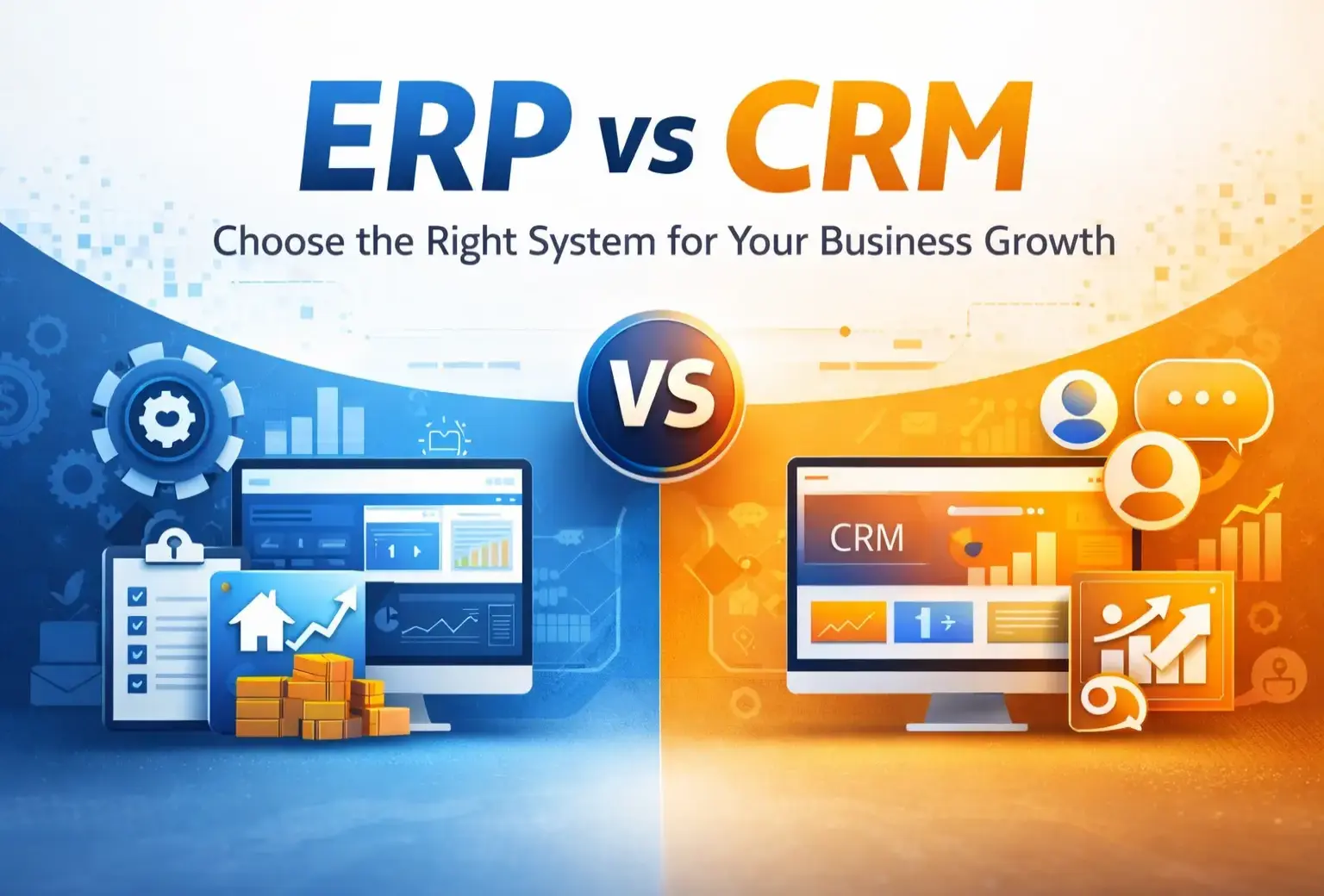
ERP vs CRM: Key Differences and Which System Your Business Needs in 2026
ERP and CRM are two of the most important software solutions for businesses today. While both help manage operations and customer relationships, they serve different purposes. Understanding their differences is crucial for selecting the right system that aligns with your business goals and growth strategy.
What is ERP?
Enterprise Resource Planning (ERP) software integrates core business processes into a single unified system. It manages areas such as finance, inventory, human resources, supply chain, and production.
- Centralizes business operations
- Provides real-time data insights
- Improves efficiency across departments
- Supports resource planning and cost control
- Ideal for large or growing businesses
ERP helps businesses streamline internal workflows, reduce operational costs, and make data-driven decisions.
What is CRM?
Customer Relationship Management (CRM) software focuses on managing customer interactions, tracking leads, sales, marketing campaigns, and support services.
- Manages customer data and communication
- Improves sales and marketing efficiency
- Supports personalized customer experiences
- Helps track leads, deals, and pipelines
- Suitable for businesses of all sizes
CRM ensures businesses maintain strong customer relationships, enhance retention, and boost sales performance.
ERP vs CRM: Key Differences
- Focus: ERP focuses on internal operations; CRM focuses on external customer interactions.
- Scope: ERP covers multiple departments; CRM is mainly for sales, marketing, and customer service.
- Purpose: ERP improves efficiency and resource management; CRM enhances customer engagement and sales.
- Users: ERP is used by accounting, HR, operations; CRM is used by sales and marketing teams.
- Data: ERP manages operational data; CRM manages customer and sales data.
Which One Does Your Business Need?
Choosing ERP or CRM depends on your business priorities:
- Choose ERP if your focus is operational efficiency, inventory management, and integrating multiple departments.
- Choose CRM if your goal is improving customer experience, sales tracking, and marketing automation.
- Many businesses implement both systems, integrating them for maximum efficiency and customer satisfaction.
Benefits of ERP and CRM Integration
Integrating ERP and CRM allows businesses to:
- Share real-time customer and operational data
- Enhance decision-making with unified analytics
- Improve customer satisfaction through better service
- Boost efficiency across all departments
- Streamline workflows from sales to delivery
FAQ
1. Can a small business use ERP?
Yes, many ERP solutions are scalable for small and medium-sized businesses to improve operational efficiency.
2. Is CRM necessary for startups?
Yes, a CRM system helps manage leads, track sales, and build strong customer relationships from the beginning.
3. Are ERP and CRM expensive?
Costs vary by features and company size. Small businesses can opt for cloud-based solutions with lower upfront costs.
4. Can ERP and CRM work together?
Absolutely. Integrating ERP and CRM provides a unified system, combining operational efficiency with excellent customer management.
5. Which system improves sales faster?
CRM directly impacts sales performance, while ERP improves operational efficiency indirectly supporting sales.
We are always ready to assist you. Please feel free to contact us for any support, consultation, or inquiries — our team is here to guide you every step of the way.